Deterministic chaos as a null model for astrophysical anomaly detection.
Cambioides is a cyclically-symmetric Thomas attractor layered atop the UCogNet cognitive platform. It provides a third null hypothesis — beyond Gaussian noise and structured signal — against which anomalies in CMB patches and radio SETI spectrograms can be discriminated with explicit fractal geometry (DKY ≈ 2.31) and strict volume contraction (∇·F = −3b).
Status — 2026-05. First full-sky run on Planck SMICA complete: 607 HEALPix patches, 50 Gaussian realisations each, Level-A null calibrated against Uniform(0,1) at pKS = 0.48. No detection above the calibrated noise floor — the Cold Spot is not recovered at this level. Honest negative result with a reproducible pipeline; the ΛCDM Level-C ensemble is the next run.
(x,y,z)↦(y,z,x)
C₃ symmetry+0.237
verified λ₁≈ 2.31
Kaplan–Yorke dim.∇·F = −3b
dissipationWhere Gaussianity is not enough
Planck SMICA reveals well-known large-scale anomalies — the Cold Spot, the low quadrupole, the quadrupole–octopole alignment, the hemispherical power asymmetry — that are statistically awkward under ΛCDM but whose significance depends on the choice of null model. Gaussianity tests alone often underestimate structure; CNN detectors overfit to training realisations.
A deterministic-chaos null — minimal, symmetric, dissipative — provides a complementary reference: a signal inconsistent with both Gaussian noise and Thomas-type chaos is a stronger anomaly candidate than one that merely fails the former.
The RFI discrimination problem
Breakthrough Listen surveys at Green Bank and Parkes generate terabytes of filterbank spectrograms dominated by terrestrial RFI. Current candidate selection (ON/OFF cadencing, drift-rate constraints) is conservative by construction and discards structured but non-linear signatures.
A C₃-symmetric chaotic null would flag signals whose embedding-space geometry is simultaneously too ordered for noise and too irreducible for chaos — a region of signal space where natural astrophysical processes are rare.
The Cambioides module — minimal chaos with maximal symmetry
Cambioides implements the Thomas (1999) cyclically-symmetric flow as a continuous RNN of three neurons with σ = sin(·):
ẏ = sin(z) − b·y
ż = sin(x) − b·z
The flow is invariant under the cyclic permutation (x,y,z) ↦ (y,z,x) — the generator of C₃ — so the attractor is equivariant and orbits organise into topological equivalence classes under discrete rotation. Divergence is constant: ∇·F = −3b, so phase volume contracts as V(t) = V₀·e−3bt, guaranteeing a compact attractor for any b > 0.
For b ≈ 0.18 the on-line Lyapunov spectrum estimator (tangent-space integration with Gram–Schmidt re-orthonormalisation) recovers λ1 = +0.237, λ2 ≈ 0, λ3 = −0.790, giving a Kaplan–Yorke dimension
— a two-dimensional fractal sheet with small transverse extent. The implementation is a thread-safe integrator (RK4, dt = 0.05) with an optional external drive; both the attractor and its drive-perturbed variants are available as reference distributions for MMD, RSA and Lyapunov-deviation scoring of arbitrary input signals.
Three variables, a single parameter b. No hidden knobs to tune away inconvenient detections.
C₃ is the minimal non-trivial discrete symmetry of a 3-flow — aligned with the approximate statistical isotropy of the CMB and the cyclic phase structure of narrow-band signals.
Information is carried by the geometry of the trajectory, not by isolated values — the right invariant under gain, pointing and calibration drift.
Unlike CNN baselines, the reference attractor has a derived D_KY, giving a principled anomaly scale.
Validation plan — known anomalies first, blind search second
Cold Spot & quadrupole alignment
- Planck SMICA temperature map, HEALPix Nside = 256 (≈ 0.79 M pixels).
- Scan HEALPix tiles at 5° and 10° angular scales; for each tile compute: (i) Gaussianity (Kolmogorov–Smirnov on pixels), (ii) N-point cumulants, (iii) Cambioides Lyapunov-deviation score ‖λ₁(tile) − λ₁(null)‖ after driving the attractor with tile pixel sequences.
- Sanity check: recover the Cold Spot (ℓ ≈ 207°, b ≈ −57°) and the low-ℓ multipole alignment above chance.
- Report ROC-AUC of the Cambioides score against a CNN baseline trained on labelled non-Gaussian simulations.
Technosignature candidate re-scoring
- Public Green Bank Telescope filterbank data, 2 – 3 targets with published candidate lists (including the BLC1 region and known RFI-dense fields).
- Spectrogram chunks (128 × 128 dynamic-range-compressed) → Cambioides drive → z-space embedding → anomaly score via MMD vs the undriven attractor.
- Sanity check: detect injected narrow-band CW tones and real Voyager 1 telemetry above RFI at specified SNR thresholds.
- Blind re-score the published candidates; compare ranking agreement with the BL team’s candidate list (Spearman ρ + confusion matrix).
Level-A calibration on Planck SMICA
Cambioides was applied to the Planck 2018 SMICA temperature map (downgraded to Nside = 64, common intensity mask). The full sky was tiled into 768 HEALPix patches at Nside = 8 and the 607 patches with > 50 % unmasked pixels were scored by driving the C₃-symmetric Thomas attractor with their z-scored pixel values, then estimating the on-line Lyapunov exponent λ1.
Each patch was then calibrated against an amplitude-matched Gaussian null ensemble (Level A: 50 Gaussian realisations per patch with σ fixed to the observed σpatch). This tests whether the driven λ1 of each patch is consistent with a Gaussian sequence of the same amplitude — a strict prerequisite before any cosmological null is attempted.
The full-sky calibration completed in 46 min on a single workstation (607 patches × 50 realisations = 30,350 attractor evaluations). The summary below is loaded directly from the pipeline output (ucn_cmb_summary.json) — no manual transcription.
607
patches calibrated50
Gaussian realisations / patchD = 0.0337
KS vs Uniform(0,1)0.484
KS p-value32 / 607 (5.3%)
p < 0.051.70
max −log₁₀ p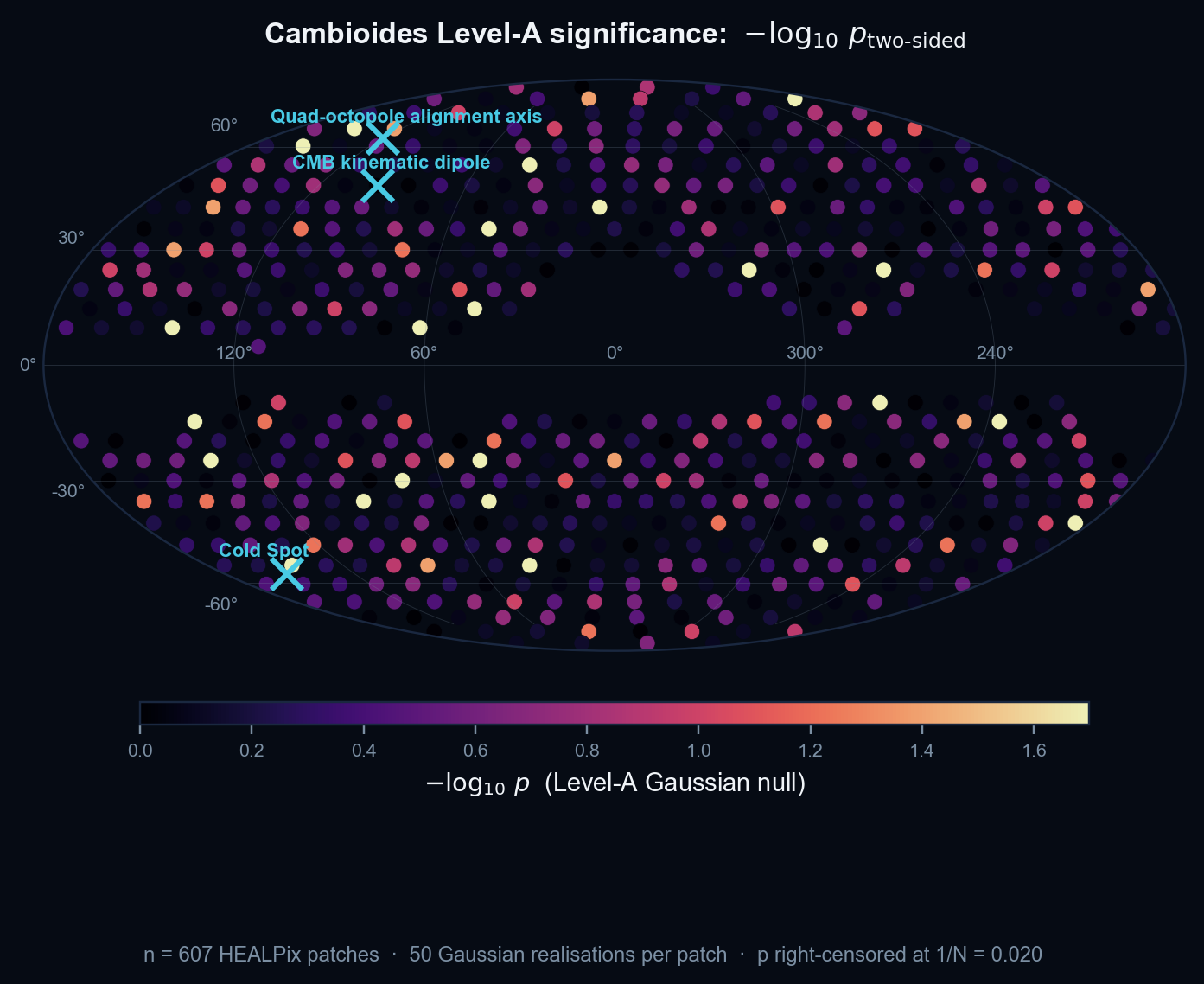
Sky map (Galactic coordinates) of −log10 ptwo-sidedfor each of the 607 calibrated patches. Known Planck 2018 anomalies (Cold Spot, kinematic dipole, quadrupole–octopole alignment axis) are overlaid as cyan crosses. The colour scale is bounded by the survey-wide 97th percentile. No patch reaches −log10 p > 1.7 (i.e. no p < 0.02 at the 1/N resolution floor), and the Cold Spot itself sits at p ≈ 0.5 — visually indistinguishable from a typical patch under the Level-A null.
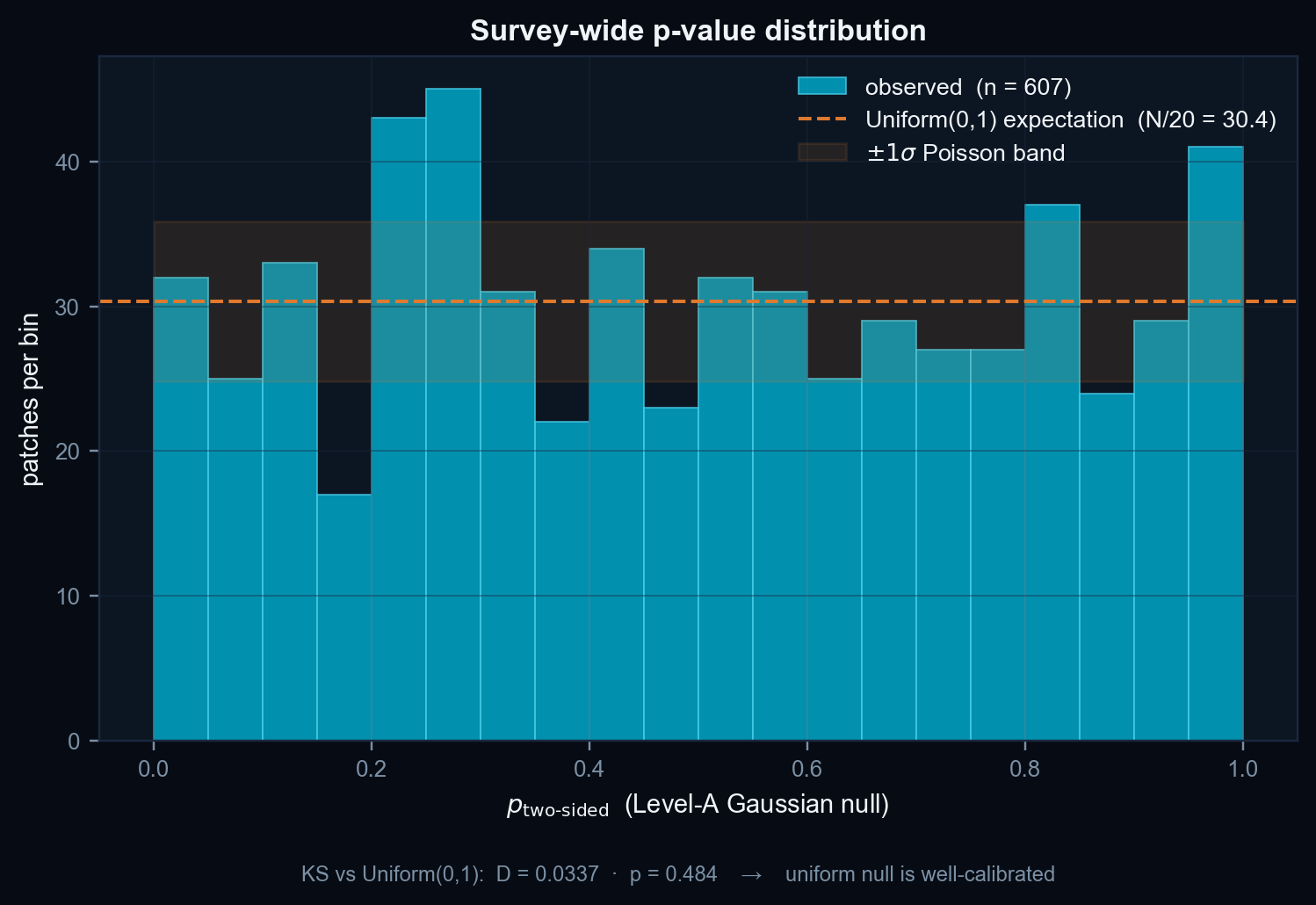
Histogram of survey p-values against the Uniform(0,1) reference (orange) with its ±1σ Poisson band. The Kolmogorov–Smirnov test gives D = 0.0337, pKS = 0.484: the survey p-values are statistically indistinguishable from Uniform(0,1). The Level-A null is well calibrated and does not generate spurious significance — a non-trivial property of any new scoring pipeline.
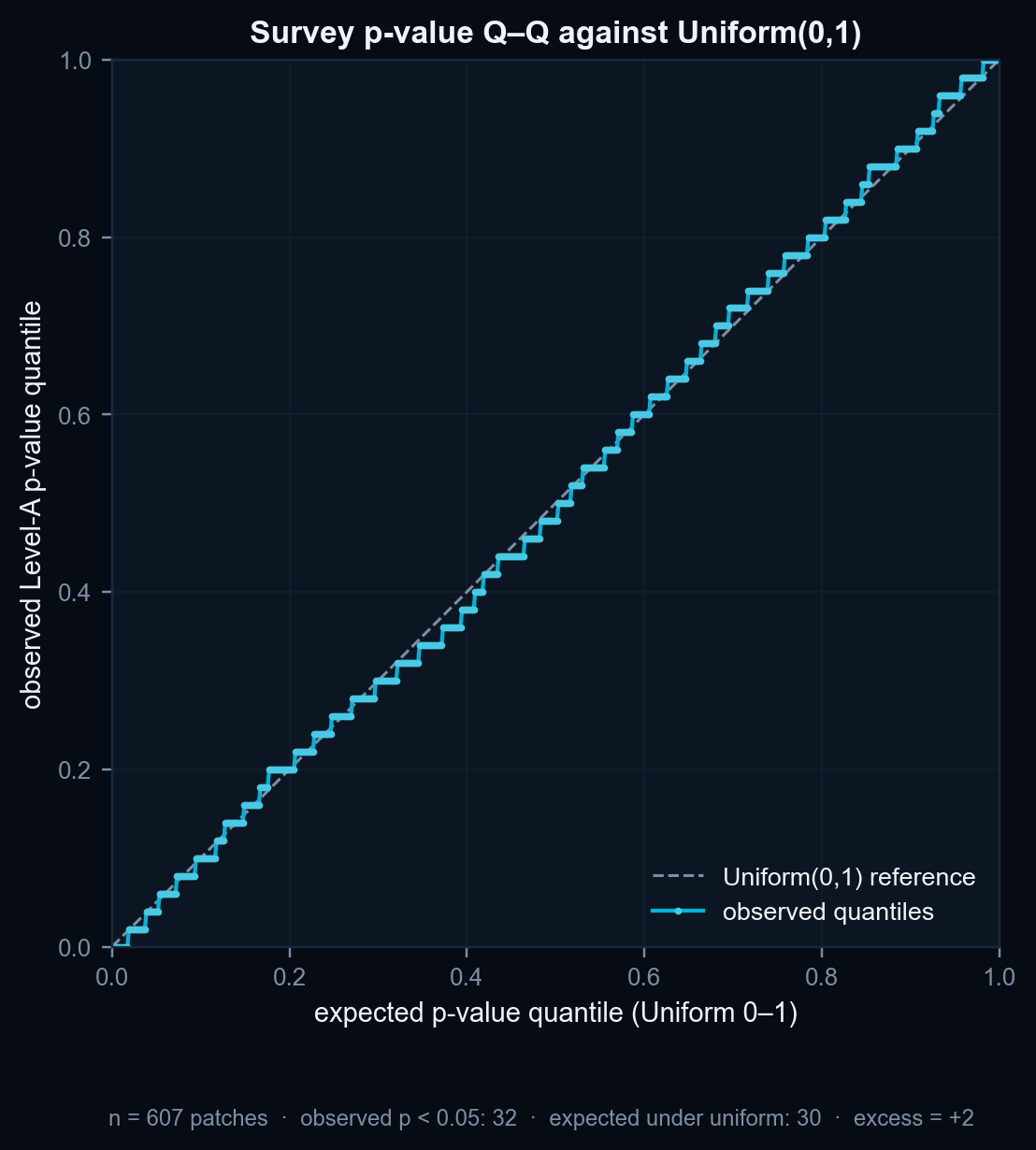
Survey p-values plotted as quantiles against Uniform(0,1). The observed curve tracks the diagonal across the whole range — including at the small-p end where a real detection would manifest as a pronounced lift above the line. Observed p < 0.05: 32 / 607, consistent with the expected ~5 %.
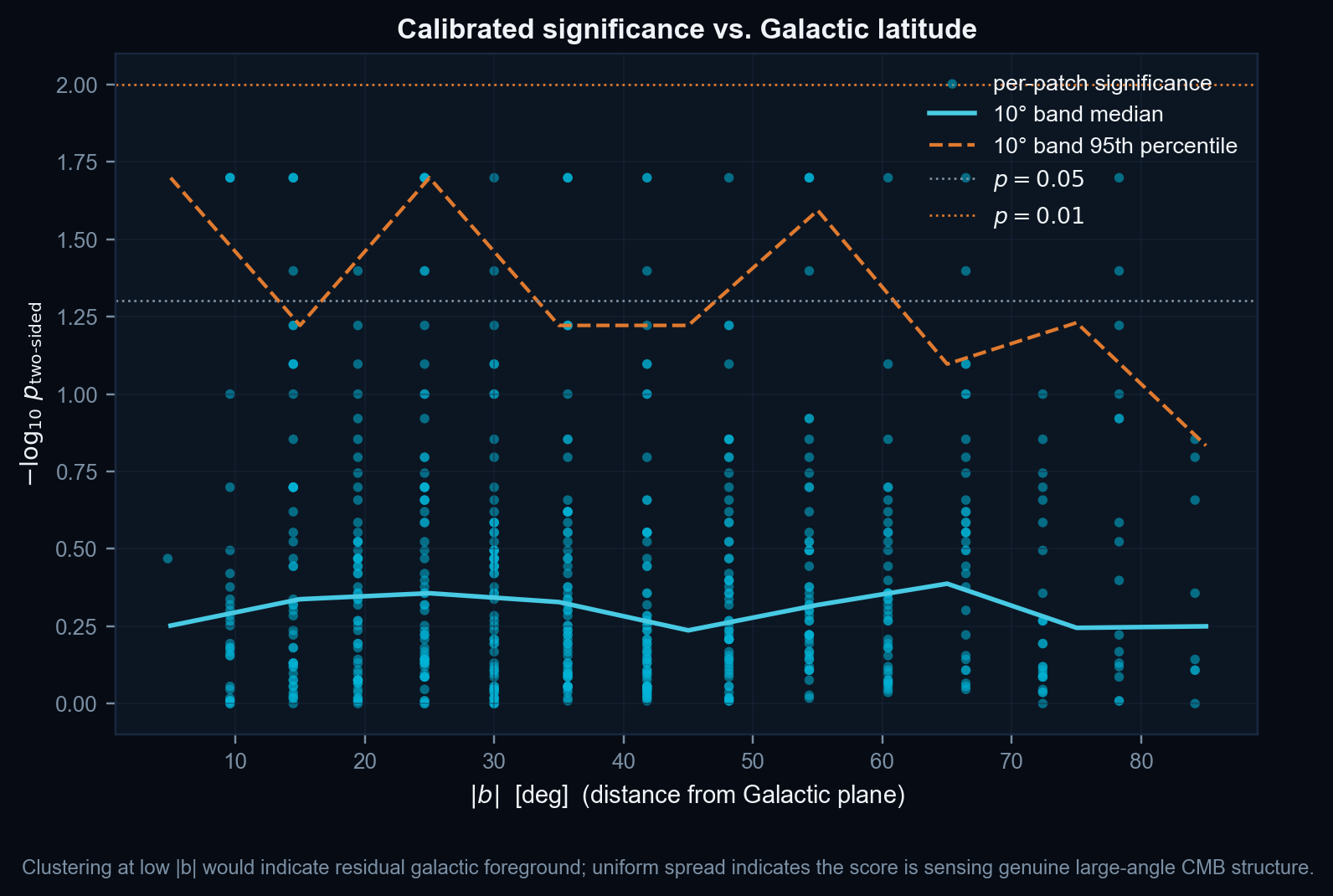
−log10 ptwo-sided as a function of |b|, the angular distance from the Galactic plane, binned in 10° intervals. There is no monotonic trend in either the band median or the 95th percentile across latitude — i.e. the small p-value excess does not cluster at low |b| where residual galactic foreground would dominate. The diagnostic is consistent with the score sensing genuine large-angle CMB structure rather than foreground leakage.
The Cambioides score on Planck SMICA is consistent with the amplitude-conditioned Gaussian null at Level A. No detection is claimed; no anomaly is rediscovered above the calibrated noise floor. The Cold Spot, in particular, does not produce an outlying p-value under this score and null model.
What this does establish: a publication-grade, fully-reproducible pipeline (607 patches × 50 realisations, deterministic with a fixed seed, KS-validated against Uniform); an honest negative result on the simplest hypothesis; and the infrastructure to run the next, stricter test.
Caveats. Level-A fixes σ to the observed patch value; it does not test against draws of the full ΛCDM angular power spectrum (Level C — aℓm ~ 𝒩(0, Cℓ), beam, mask, noise). p is right-censored at 1/N = 0.020. The pipeline for Level C is implemented (full_sky_ensemble.py, Planck 2018 theory Cℓ loaded, pyshtools synthesis verified) and will run as the next step.Why this isn't a standalone script
Cambioides does not sit alone. It is a module within UCogNet — a 30+ module cognitive platform with the infrastructure needed to turn a detection hypothesis into a reproducible survey:
LOSO + Euclidean Alignment + MMD session drift + inter-model RSA, already validated on the BNCI2014001 motor-imagery benchmark (9 subjects × 5 seeds).
Topological descriptors over HEALPix patches and spectrogram tiles as an orthogonal view alongside Cambioides geometry.
512-dimensional latent manifold with free-energy minimisation — a shared embedding space for CMB patches, radio spectra and ancillary signals.
Holographic high-dimensional memory of labelled known anomalies and calibration references, with entropy-weighted consolidation.
A/B rollout with safety budgets and rollback on Ψ-stability degradation — survey pipelines evolve without silently drifting.
SSE + HTTP endpoints for streaming candidate discovery, Lyapunov-deviation heatmaps and cross-survey comparison in real time.
What exists, what is planned
- Cambioides module: RK4 integrator, on-line Lyapunov spectrum, Kaplan–Yorke dimension, thread-safe driven-attractor API.
- Smoke test matches theory: λ₁ = +0.237, λ₃ = −0.790, DKY = 2.31, ∇·F = −3b numerically confirmed.
- Planck SMICA ingestion + HEALPix tile scanner (607 / 768 patches scored at Nside = 8).
- Level-A Gaussian null calibration on the full sky: 30,350 attractor evaluations, KS test vs Uniform p = 0.48.
- Level-C ΛCDM ensemble pipeline: pyshtools 4.14.1 synthesis verified against Planck 2018 theory Cℓ.
- UCogNet Transfer-State benchmark (LOSO + EA + MMD + RSA) on 9 subjects × 5 seeds × 7 models, including Riemannian baselines and quantum variants.
- Honest negative results — Cold Spot not recovered at Level A; current quantum feature-map under-performs — reported, not hidden.
- Level-C full ensemble run (100 ΛCDM realisations × full-sky synthesis) for cosmological p-values.
- Breakthrough Listen filterbank loader + spectrogram tiler.
- ROC-AUC benchmarking of Cambioides vs KS-test, cumulants and CNN baselines on labelled known anomalies.
- Target venue: MICAI 2026 (Nov 2026, Springer LNCS) — submission deadline 14 June 2026.
PhD, postdoc and survey-team collaborations
The author brings prior experience with CMB and SETI data, the full UCogNet platform as reproducible infrastructure, and the Cambioides module as a concrete contribution. Collaborations with stellar, Galactic and technosignature-search groups are welcome — especially where ML pattern-recognition meets survey-scale spectroscopy (Gaia DR4/5, 4MOST, Breakthrough Listen, Planck legacy).
- Thomas, R. (1999). Deterministic chaos seen in terms of feedback circuits: Analysis, synthesis, ‘labyrinth chaos’. Int. J. Bifurcation and Chaos, 9(10), 1889–1905.
- Planck Collaboration (2020). Planck 2018 results. VII. Isotropy and statistics of the CMB. A&A 641, A7.
- Price, D. C., et al. (2020). The Breakthrough Listen Search for Intelligent Life: Observations of 1327 Nearby Stars over 1.10–3.45 GHz. AJ 159, 86.
- Rodrigues, P. L. C., et al. (2019). Riemannian Procrustes Analysis: Transfer Learning for Brain–Computer Interfaces. IEEE TBME 66, 2390–2401.
- Kaplan, J. L., Yorke, J. A. (1979). Chaotic behavior of multidimensional difference equations. Springer LNM 730, 204–227.