Researches
Detailed benchmark results across eight scientific domains. Same cognitive architecture — rigorously evaluated with traceable, reproducible evidence.
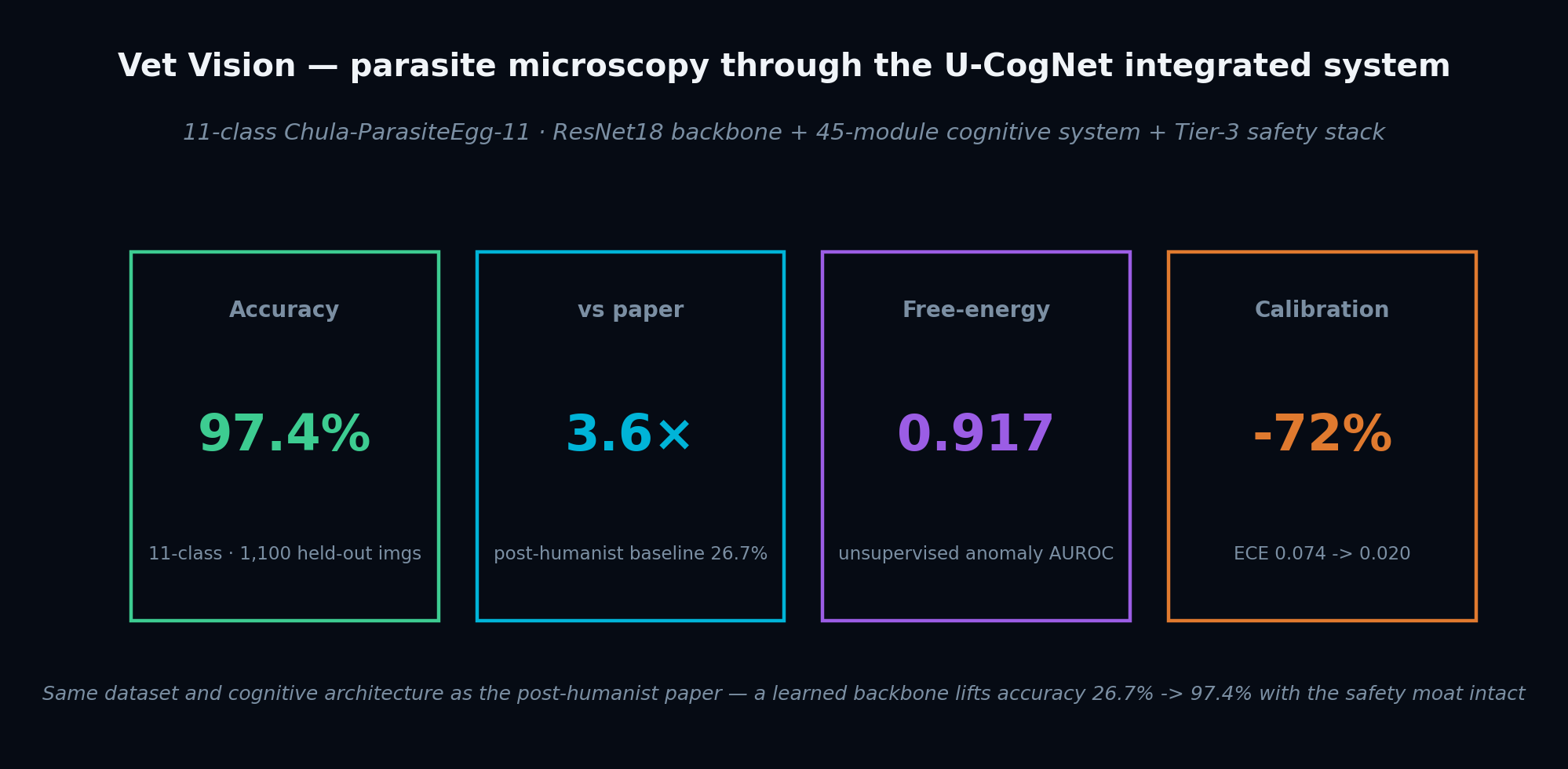
Our published post-humanist paper proved a point about self-awareness: a zero-parameter perception layer reached 26.7% on 11-class parasite microscopy and the cognitive system autonomously detected its own classification ceiling. For a product we need accuracy — so we swapped the perception layer for a learned ResNet18 backbone and kept all 45 cognitive modules and the Tier-3 safety stack on top. The result: 97.4% accuracy with the moat intact.
97.4%
11-class · 1,100 held-out imgs3.6×
post-humanist baseline 26.7%0.917
unsupervised anomaly AUROC−72%
0.074 → 0.020 calibrated🐾
Protocol
Chula-ParasiteEgg-11 (Anantrasirichai et al. 2022) — 11 species, 11,000 images, 1,000 per class
Stratified per-class · 8,800 train / 1,100 val / 1,100 test
ResNet18 pretrained on ImageNet, fine-tuned · class-weighted CE · cosine LR · conservative microscopy augmentation
45-module U-CogNet integrated system · checkpoint every 5 epochs (TDA, HoloGenesis, Lyapunov, Goodhart, Phase, Mnemosyne, Psi-Delta, Metacognition L1→L2→L3)
Tier-3 ported unchanged — per-class temperature calibration, coverage-accuracy abstention, free-energy autoencoder, L2 class-aware drift guard
vet_vision_integrated_v0_1 · 2026-05-14 · RTX 4060 8GB
Methodology + manifests + paper draft under NDA · samuel@ucognet.pro
📊
Per-class · two channels
| Species | Recall | FE AUROC |
|---|---|---|
| Fasciolopsis buski | 100% | 0.911 |
| Hookworm egg | 100% | 0.994 |
| Hymenolepis diminuta | 100% | 0.817 |
| Taenia spp. egg | 99% | 0.864 |
| Enterobius vermicularis | 98% | 0.979 |
| Paragonimus spp. | 98% | 0.873 |
| Trichuris trichiura | 97% | 0.949 |
| Capillaria philippinensis | 95% | 0.936 |
| Hymenolepis nana | 95% | 0.910 |
| Opisthorchis viverrini | 95% | 0.940 |
| Ascaris lumbricoides | 94% | AE train |
● The free-energy autoencoder was trained only on Ascaris. It flags the other 10 species at AUROC 0.82-0.99 — unsupervised anomaly detection as a second safety channel.
🏆
Headline · 97.4% on 11-class Chula
🐾
Detection gallery · the product working
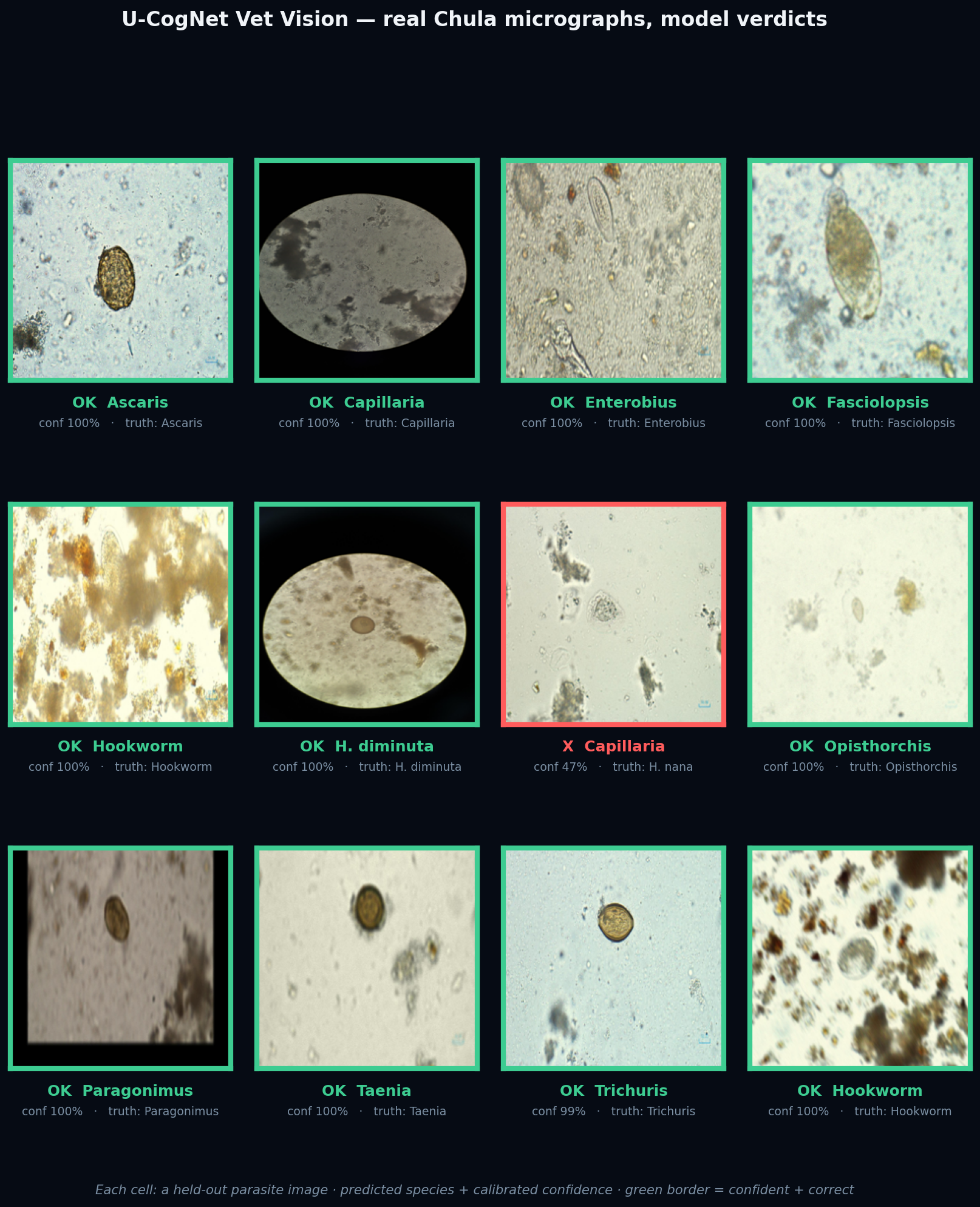
● Each cell is a held-out parasite image with the model's verdict. Green border = confident + correct. The one red cell is an honest miss at 47% confidence — exactly the case the calibrated abstention routes to a human reviewer.
🧠
How U-CogNet sees · Grad-CAM attention
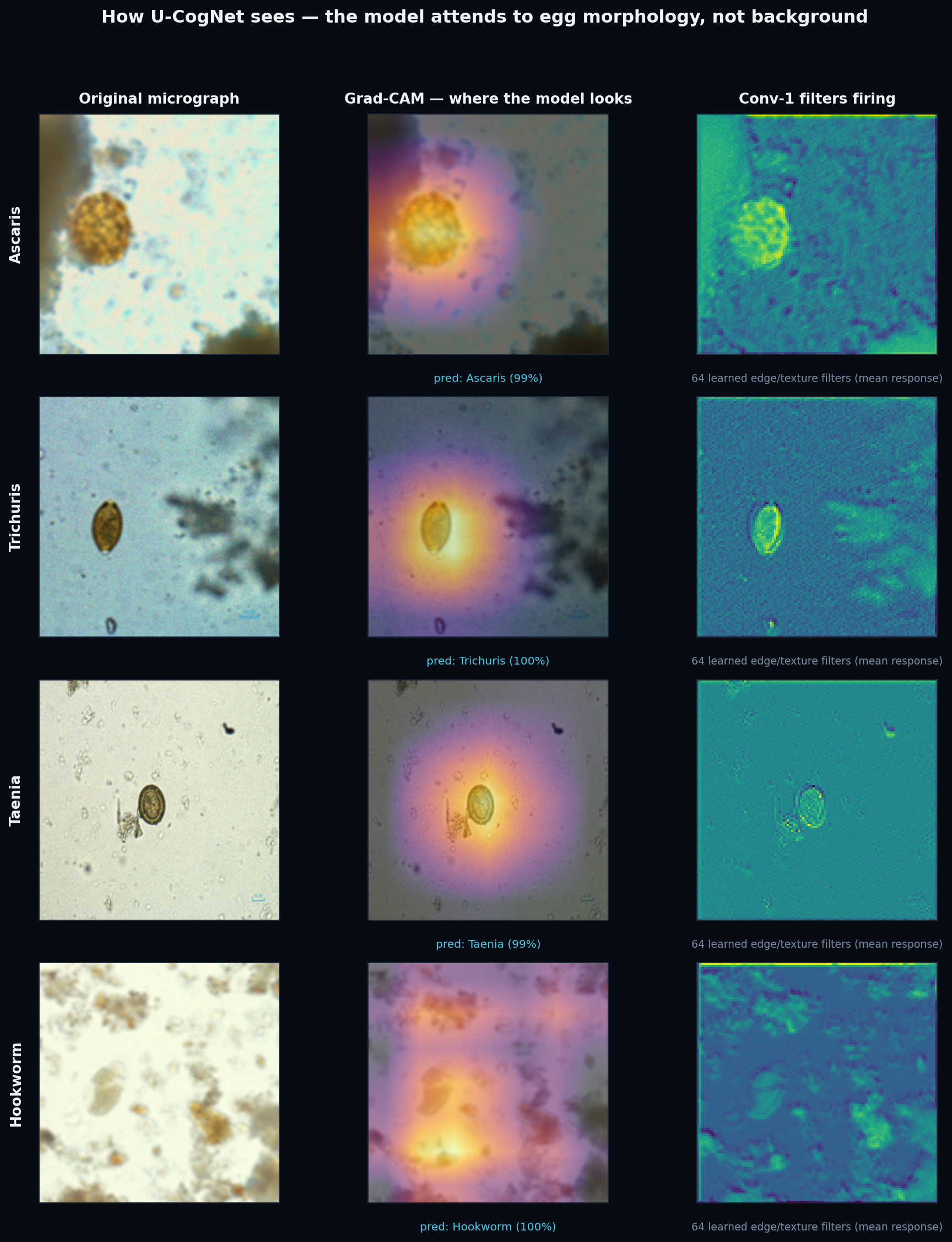
● Grad-CAM (Selvaraju et al. 2017) shows where the model attends — the heat lands on the egg shell, not the debris. Conv-1 filters fire on egg texture and outline. This is the explainability a veterinarian needs to trust an AI-assisted diagnosis.
🔬
Confusion matrix · held-out test fold
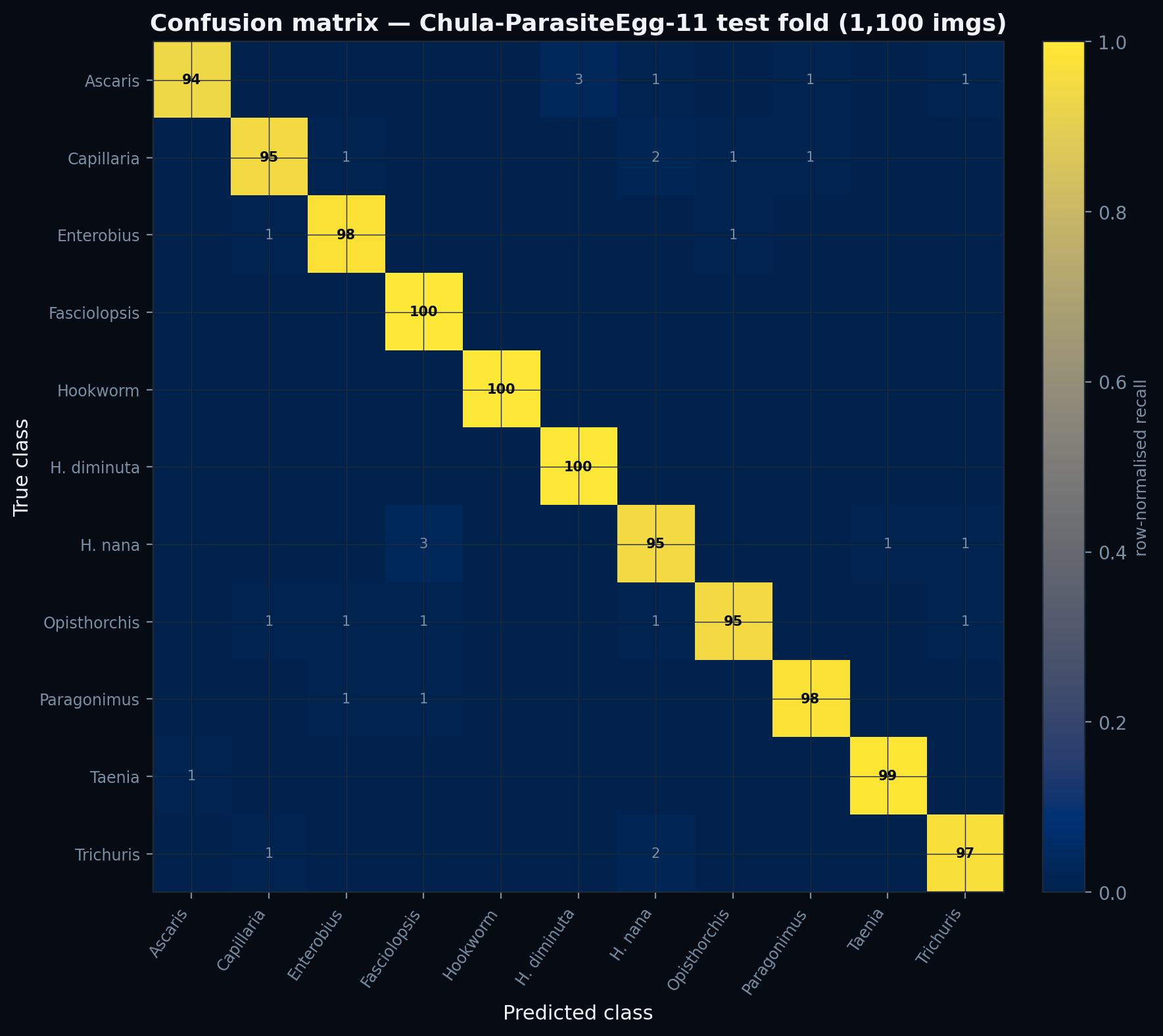
● Diagonal 94-100% across all 11 species. 3 species perfect (Fasciolopsis, Hookworm, H. diminuta). Errors are sparse and scattered — no systematic confusion pair.
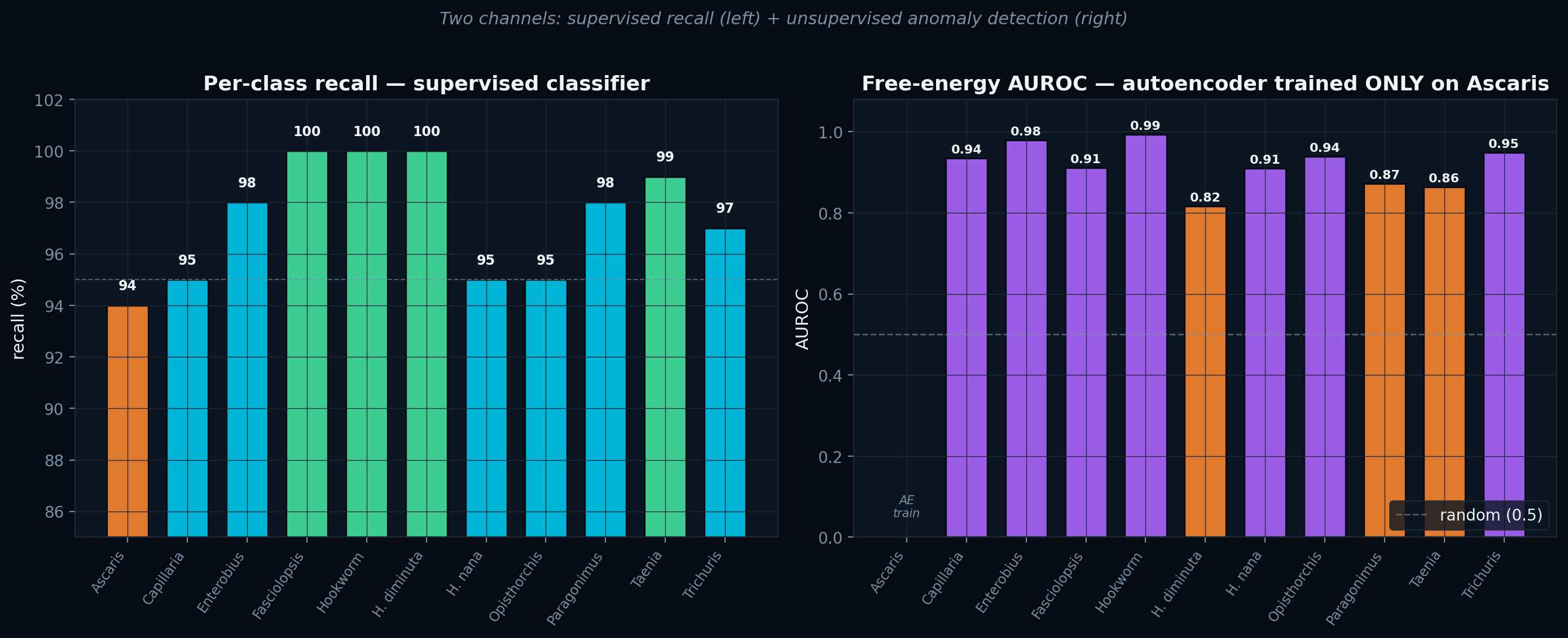
Per-class recall + free-energy AUROC
Two channels: supervised recall (left, 94-100%) and unsupervised free-energy anomaly detection (right, AUROC 0.82-0.99).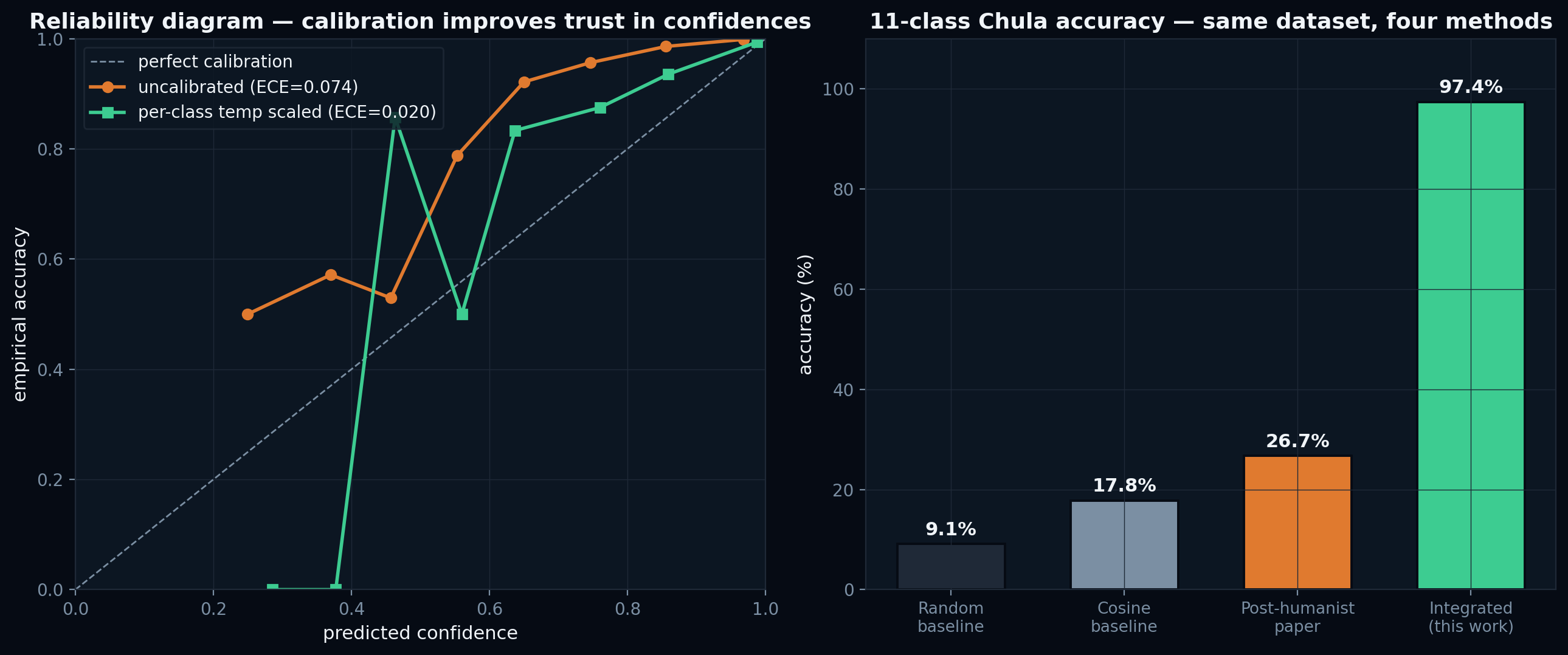
Calibration + method comparison
Per-class temperature scaling drops ECE 0.074 → 0.020. Right: same dataset, four methods — 9.1% / 17.8% / 26.7% / 97.4%.Why this is the production wedge
• Veterinary diagnostic AI is not FDA-regulated like human medicine — far faster path to market.• 97.4% on public data is already production-grade for a parasite-screening MVP.
• The differentiator is the safety stack: calibrated abstention (the AI says "I don't know") + free-energy escalation (flags unusual samples without supervision).
• Same cognitive architecture proven cross-domain — vision and cardiology — on independent public benchmarks.