Researches
Detailed benchmark results across eight scientific domains. Same cognitive architecture — rigorously evaluated with traceable, reproducible evidence.
Standard CV treats microscopy through eye-shaped operators — RGB statistics, V1-modelled convolutions, end-to-end trained encoders. We propose a post-humanist alternative: five orthogonal modal axes (visual chromatic · acoustic spectral · tactile resonance · topological imprint · synesthetic coherence) with zero learned parameters. The principal finding is not the accuracy. It is that U-CogNet's integrated cognitive system autonomously detected its own classification ceiling via metacognition L2 — three independent modules concurred on the diagnosis.
🔬
Protocol
Chula-ParasiteEgg-11 (Anantrasirichai et al. 2022) — 11 parasitic egg classes, public Kaggle mirror
200 train + 50 held-out per class · 2,200 / 550 total images · deterministic split
64-D post-humanist embedding · 5 axes · zero learned parameters
Single linear layer · SGD + momentum + cosine LR · 200 epochs · batch 32 · lr0=0.3
Integrated cognitive system · topological + holographic + stability + metacognition layers · checkpoint every 20 epochs
parasite_train_integrated_v0_1 · 2026-05-08
Methodology + manifests under NDA · samuel@ucognet.pro
Palasuwan et al., IEEE Access 2022, doi:10.1109/ACCESS.2022.3142055
🎵
Five modal axes
Visual chromatic
12-DAcoustic spectral
16-DTactile resonance
12-DTopological imprint
12-DSynesthetic coherence
12-D🏆
Headline accuracy
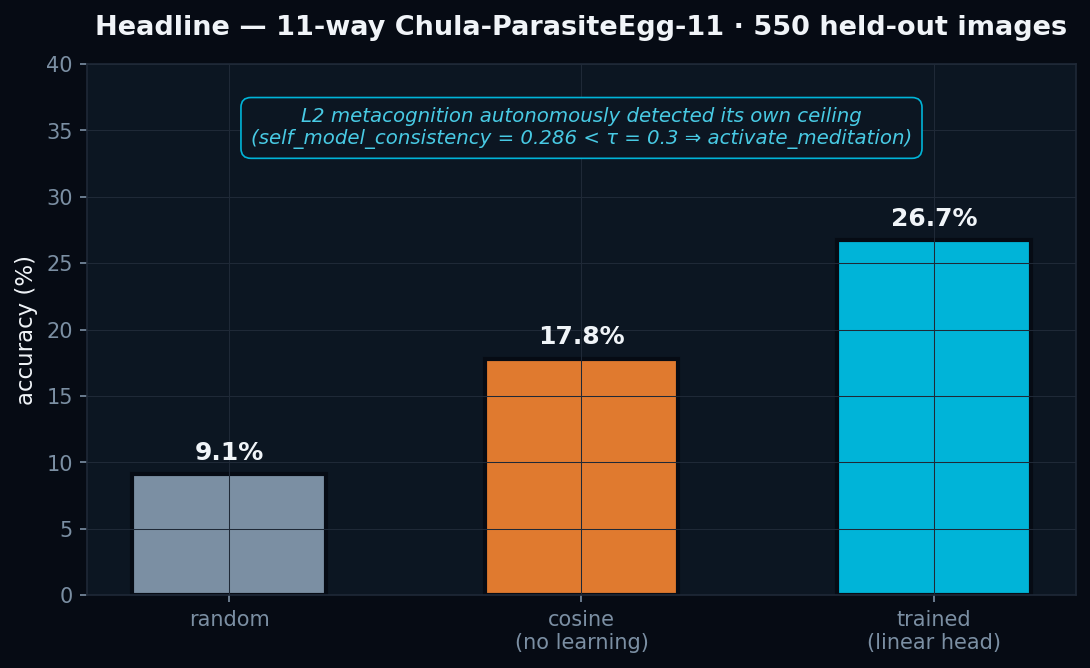
● 26.7% accuracy · 3× random · +8.9 pp over the cosine baseline (≈ +50% relative). Single linear layer on top of the frozen perception — this is the floor for how separable the 5-axis embedding is. YOLOv8 reaches 90%+ with the full train split + augmentation; our contribution is methodological, not absolute accuracy.
🧠
Self-aware metacognition — the finding
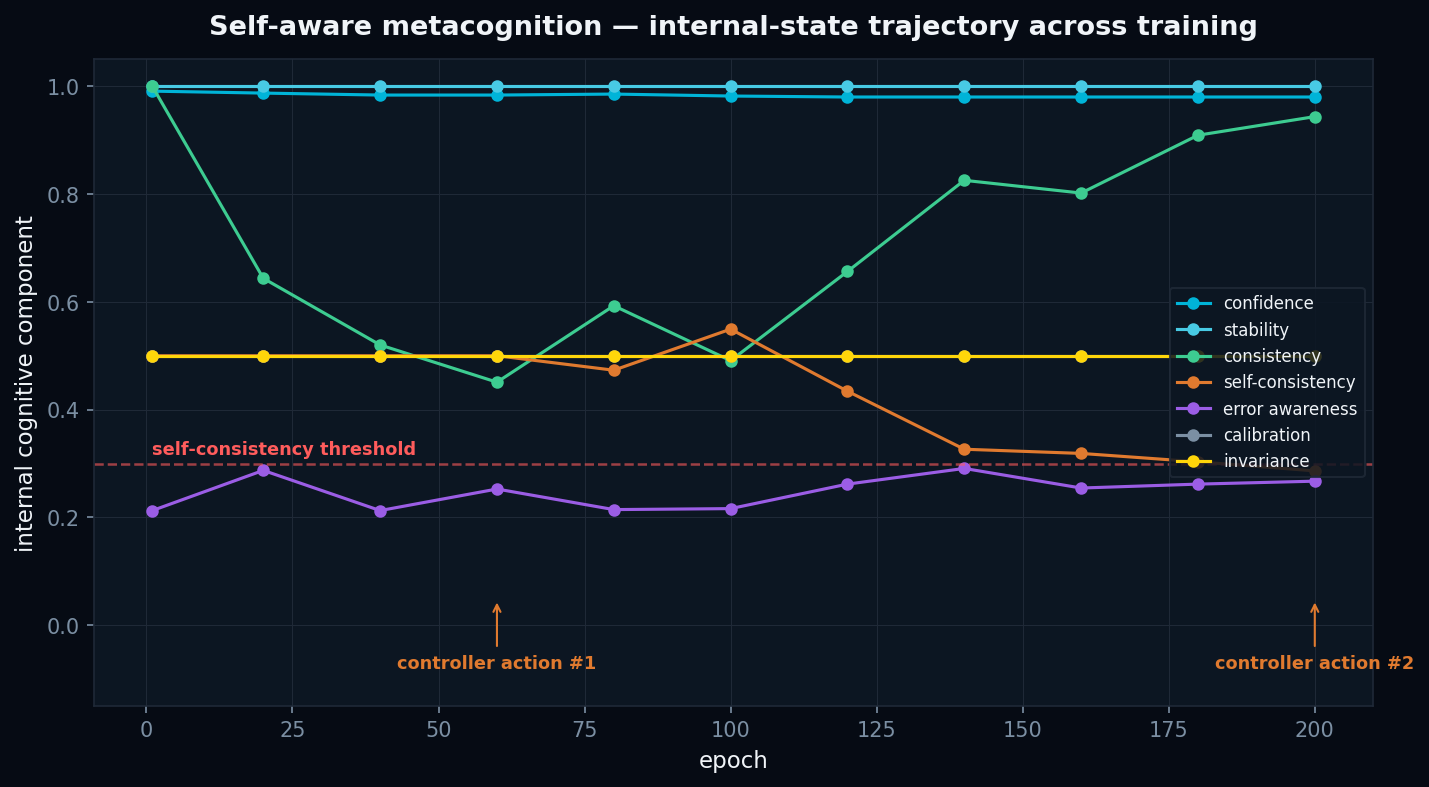
During training, the metacognition controller emitted aninternal adaptation actionafter a self-consistency component of the cognitive state vector fell below its configured threshold (observed 0.286 against a cut-off of 0.3). Three independent cognitive modules concurred on the diagnosis:
Topological
Loop count climbs across training — prediction space gains topological loops as the head saturates
Holographic
Bulk reconstruction fidelity is negative throughout (-0.92 avg) — the head operates in a low-information regime
Cross-modal
Modal harmony stays at 0.034 (dissonant) — the modal axes do not converge on the head's predictions
📊
Per-class recall
| Class | Cosine | Trained | Δ |
|---|---|---|---|
| Capillaria philippinensis | 58% | 60% | +2 pp |
| Hymenolepis nana | 70% | 58% | -12 pp |
| Hymenolepis diminuta | 28% | 50% | +22 pp |
| Hookworm egg | 4% | 42% | +38 pp |
| Enterobius vermicularis | 26% | 30% | +4 pp |
| Opisthorchis viverrini | 0% | 18% | +18 pp |
| Paragonimus spp. | 0% | 18% | +18 pp |
| Trichuris trichiura | 4% | 10% | +6 pp |
| Taenia spp. egg | 2% | 4% | +2 pp |
| Fasciolopsis buski | 0% | 2% | +2 pp |
| Ascaris lumbricoides | 4% | 2% | -2 pp |
● Coherence (computed before any training) ranks classes by classification difficulty consistently with the empirical recall. Ascaris — the lowest-coherence class — is also the worst-classified. Two independent measurements concur. The synesthetic-coherence score is a candidate confidence-without-labels signal for clinical deployment.
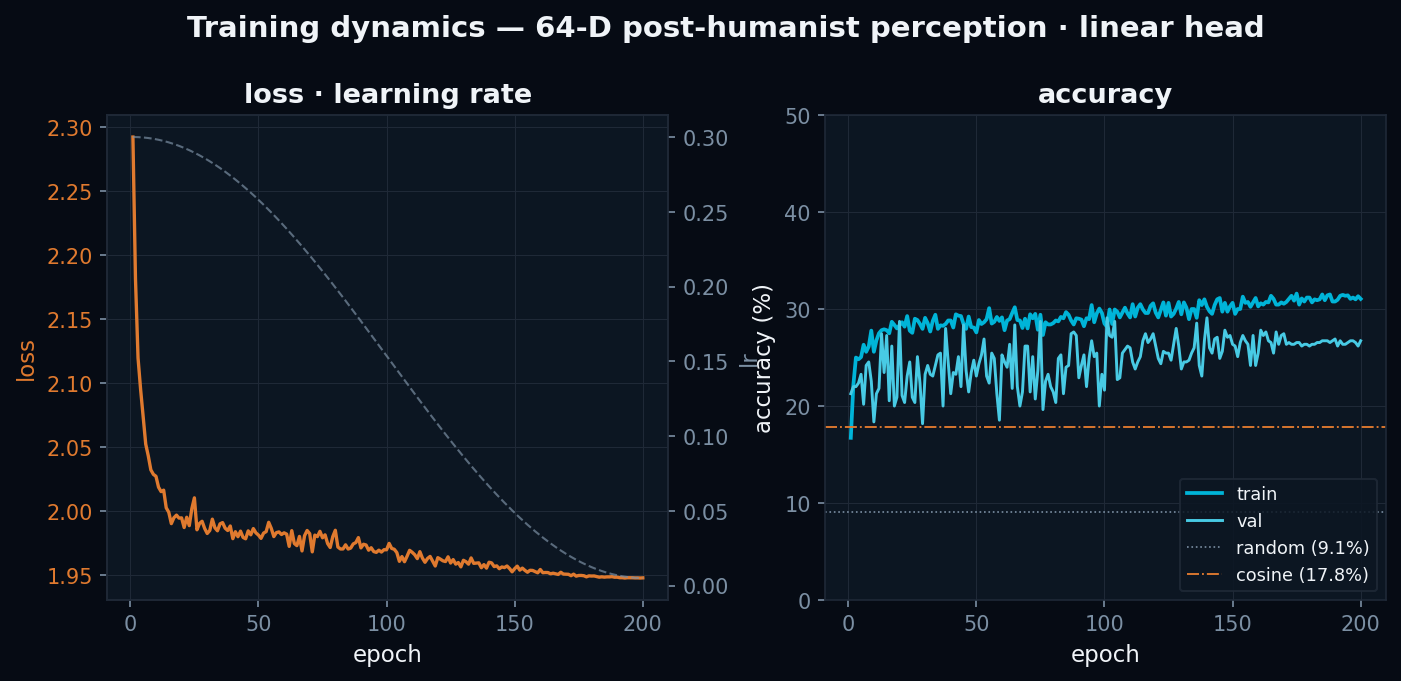
Training dynamics
Loss converges fast (~epoch 20) and plateaus near 1.95 — the linear head exhausts the perception layer's separability quickly. Validation accuracy stabilises around 27% with a small train/val gap (~4 pp) — no overfitting, just representational ceiling.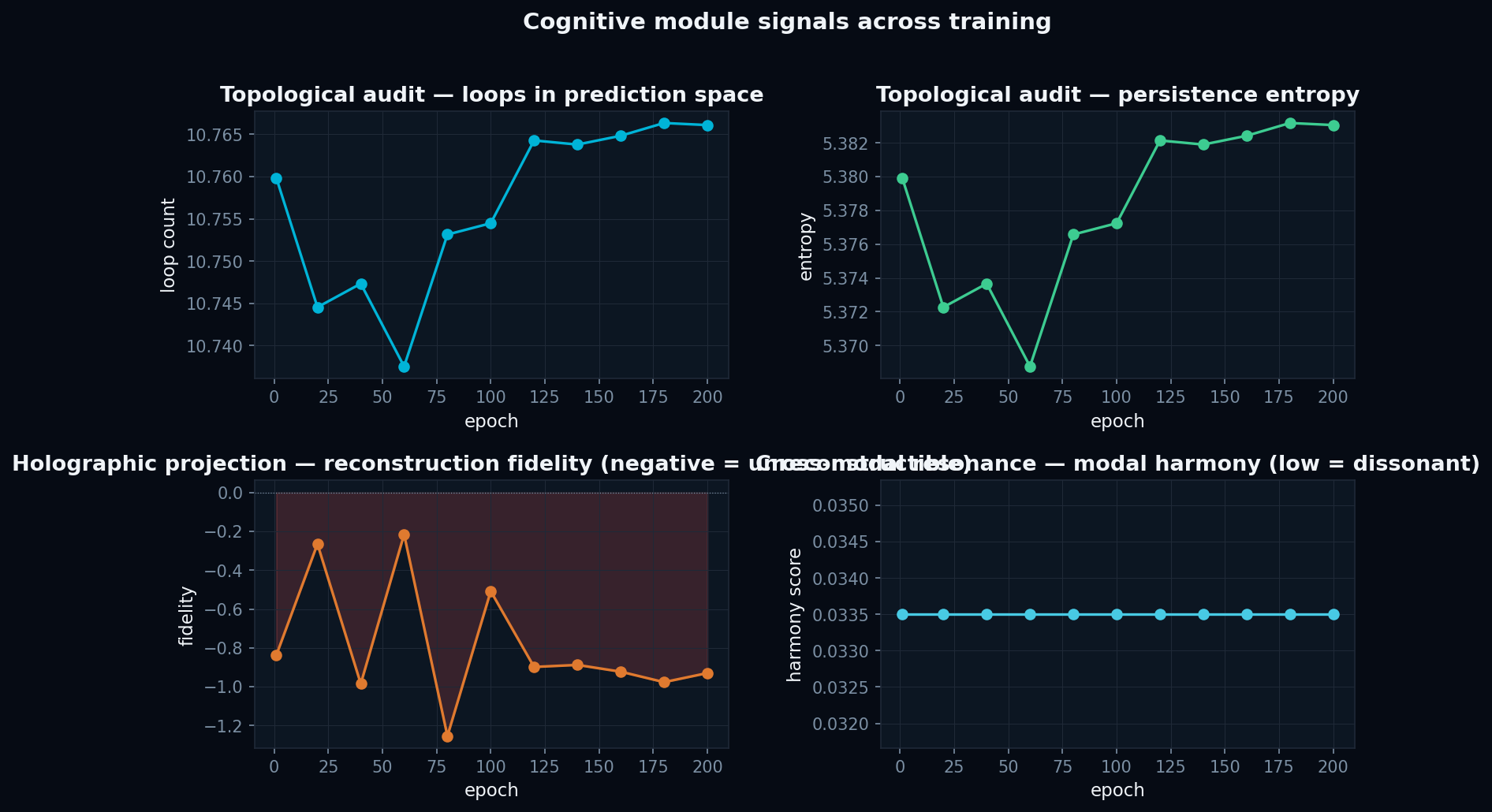
Cognitive module signals
Three independent integrated modules concur with the controller verdict: a topological audit (loop count rising), a holographic-projection layer (reconstruction fidelity negative throughout), and a cross-modal resonance check (modal harmony stays low, dissonant). All three flag the same ceiling.